
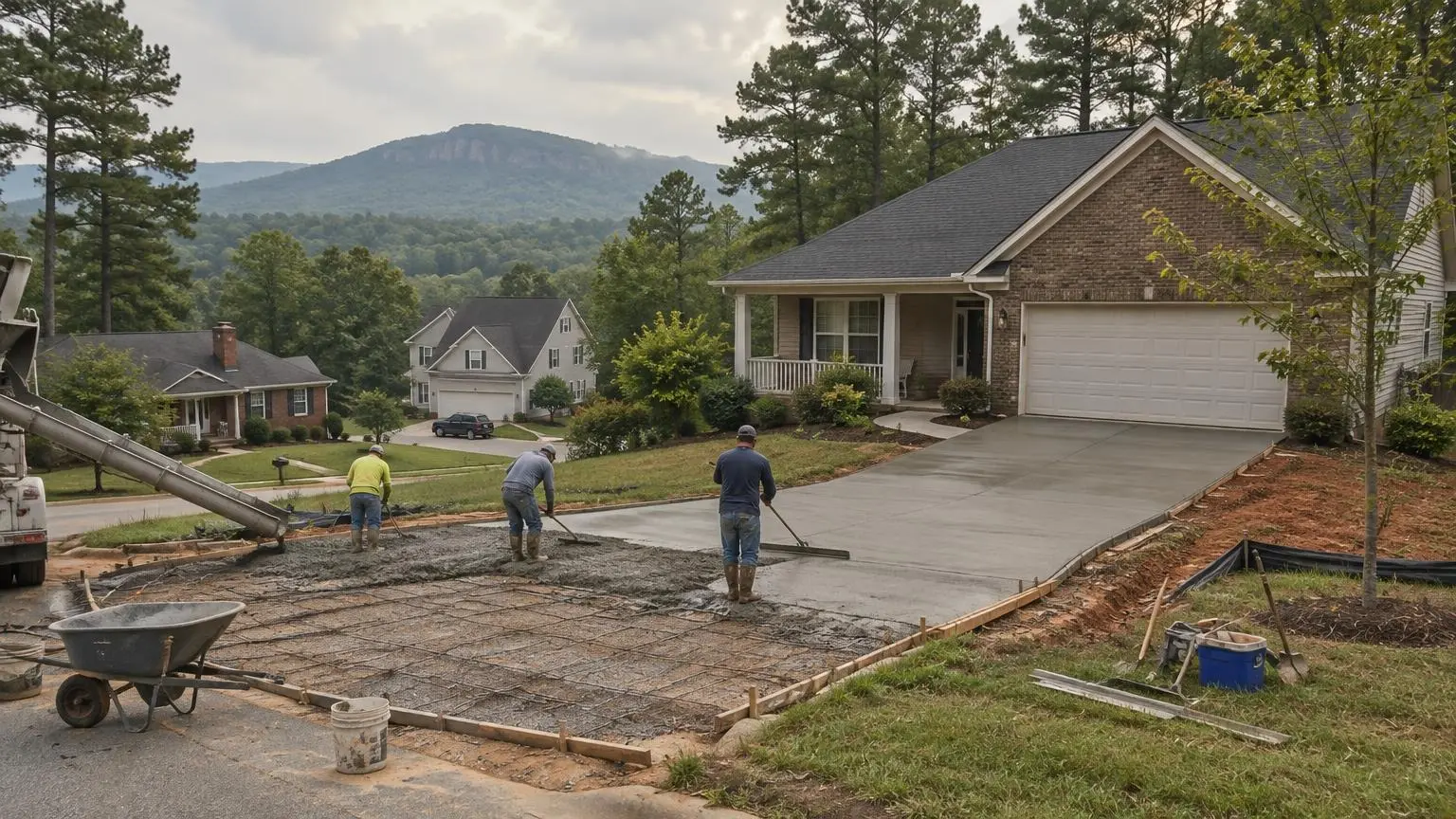
Driveways, patios and flatwork in Gaston County
Concrete Contractors in Gastonia, NC
Flatwork planned around Piedmont red clay, sloping yards, summer downpours and the odd hard freeze.
- Estimates are free and done on site, with slope and drainage checked
- Every price comes in writing, line by line
- Street-side driveway work checked against City of Gastonia apron rules
Concrete Built for the Piedmont
As concrete contractors for homes in Gastonia, North Carolina, and the Gaston County towns around it, we handle driveways, patios, stamped surfaces, walkways and slabs, plus repairs to concrete that is cracked, sunken or worn. Gastonia is the county seat and sits roughly 21 miles west of Charlotte on I-85. It was incorporated in 1877 and grew as a textile center, so its houses span more than a century: about half were built before 1980, and about a quarter since 2000. Those two groups of homes fail in different ways, and we plan each job around the house and lot in front of us.
Local weather and your slab
Gastonia winters are gentle by northern standards, but they are not frost-free. NOAA's 1991 to 2020 normals put the average January low at about 31 degrees, so many winter nights land right at the freezing mark. Water sitting in a crack or soaked into a porous surface freezes overnight, swells, and thaws by afternoon. Snow averages only about 1.2 inches a year, which keeps de-icing salt to a minimum, yet those freeze-thaw nights still wear on concrete over the decades.
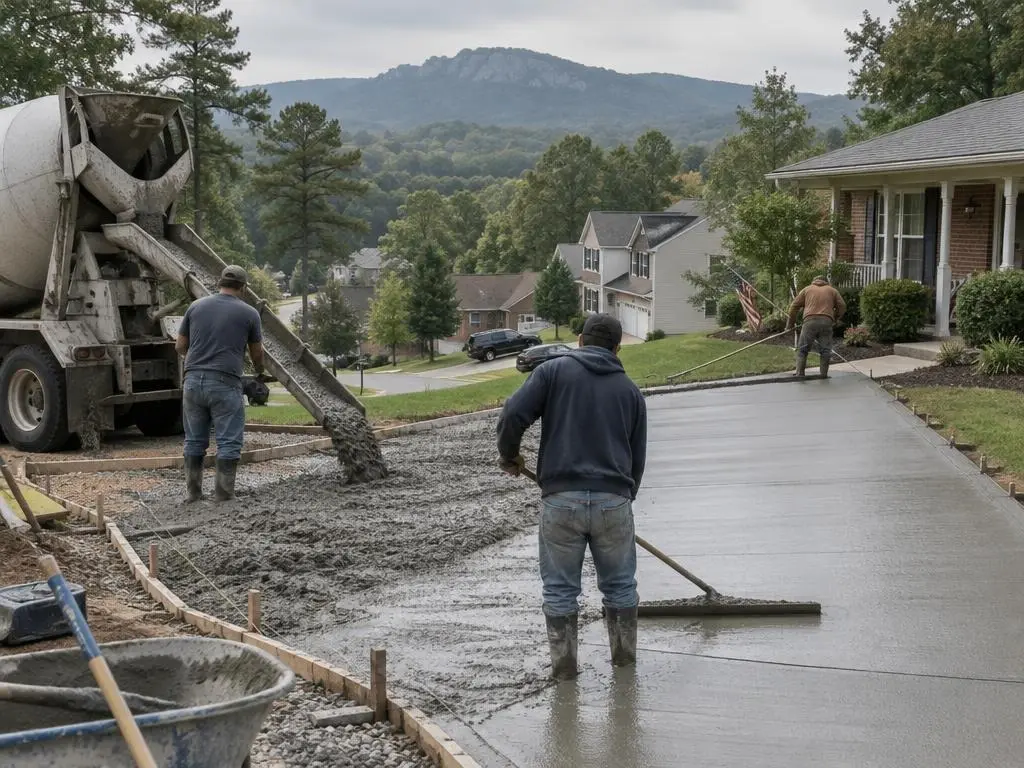
The bigger threats come in summer. Average July highs reach about 91 degrees, and the city sees close to 44 inches of precipitation a year, with June and August among the wettest months. Fresh concrete in that heat can stiffen before it is finished and lose surface moisture too fast. A thunderstorm an hour after a pour can scar the surface. So in summer we start early in the day, track the radar, and keep new slabs wet or under a curing compound.
Clay soil and hilly yards
Gaston County sits in the southern Piedmont, which the county describes as gently rolling ground broken by hills, creek valleys and low ridges. Kings Pinnacle in Crowders Mountain State Park climbs more than 800 feet above Gastonia just west of the city. Underfoot, much of the region is red clay. Cecil, the official state soil, is mapped across the Piedmont and has a red subsoil dominated by kaolinite. Clay like that holds water, swells, then shrinks as it dries, and a slab poured straight onto it will usually tilt or crack.
For that reason, the part of the job you never see gets the most attention. Topsoil and roots come out. The subgrade gets compacted. Crushed stone goes in and gets compacted again. On sloped yards we set the finished grade so rain sheds off the concrete and away from the foundation, and we look for low spots where street runoff or a neighbor's downspout will gather.
Concrete on older houses
Census survey figures put the median year built for Gastonia homes at 1978. About 52 percent of the city's housing predates 1980, and close to 15 percent predates 1950. The Loray Mill and Downtown Gastonia historic districts, both on the National Register, mark the mill era the city grew out of.
Concrete around houses that old was often placed thin, with no steel and no stone underneath. Decades of clay movement and tree roots leave walks heaved, driveways broken into plates and porch steps pulling away from the house. A patch or leveling job is sometimes enough. When the slab has lost its support, starting over on a proper base is the better use of your money, and we explain which case you have.
Concrete on newer houses
Roughly one Gastonia home in four was built in 2000 or later. These houses usually came with a basic driveway and a small pad at the back door. Owners tend to want more: a wider drive, a parking spot beside the garage, a real patio, a path to the back gate or a shed pad. New work is tied to the old with dowels or separated with an isolation joint, and we finish it to sit level with what is already there while keeping water moving off the lot.
Included on every job
- An on-site visit covering measurements, grade, soil, runoff and truck access
- A written price listing depth, base, steel, finish and joint plan
- Break-out and disposal when old concrete is being replaced
- Compacted soil under a compacted crushed stone base
- Forms set to grade, with rebar or mesh where the load needs it
- Air-entrained mix for outdoor slabs, finished and jointed
- A proper cure, then written dates for foot traffic, vehicles and sealer
The apron and the city
When a driveway meets the street, the last stretch inside the public right-of-way is the apron, and the City of Gastonia issues driveway permits for that piece. The city's page says the private portion outside the right-of-way needs no driveway permit. It also sets minimum insurance requirements for work inside city right-of-way, requires a formal encroachment agreement for construction that reaches into city right-of-way or easements, and notes that commercial aprons on NCDOT streets need a state permit. We confirm what applies to your address before booking the pour, and outside city limits we check with the town or county instead.
Where We Work
Gastonia is where we are based, from the streets near downtown and the Loray Mill district to newer neighborhoods off I-85 and US 321. Around it, we cover Belmont, Mount Holly, Cramerton, McAdenville, Lowell, Ranlo, Dallas, Stanley, Bessemer City, Cherryville and Kings Mountain in Gaston County, Lincolnton and Denver to the north, Shelby to the west, and Clover, Lake Wylie, Tega Cay, York, Fort Mill and Rock Hill across the South Carolina line. Each town has its own history and ground. Cramerton began as a planned mill village, Ranlo still has mill row houses from the 1920s and 1930s, and McAdenville grew around its mill on the South Fork. Belmont, Lake Wylie and Tega Cay sit on peninsulas formed by the Catawba River and Lake Wylie, while Bessemer City, Cherryville and Kings Mountain sit higher, at 900 feet and up. Every town page explains what that means for concrete there.
- Concrete Contractors in Gastonia, NC
- Concrete Contractors in Belmont, NC
- Concrete Contractors in Mount Holly, NC
- Concrete Contractors in Cramerton, NC
- Concrete Contractors in Lowell, NC
- Concrete Contractors in McAdenville, NC
- Concrete Contractors in Ranlo, NC
- Concrete Contractors in Dallas, NC
- Concrete Contractors in Stanley, NC
- Concrete Contractors in Bessemer City, NC
- Concrete Contractors in Cherryville, NC
- Concrete Contractors in Kings Mountain, NC
- Concrete Contractors in Lincolnton, NC
- Concrete Contractors in Shelby, NC
- Concrete Contractors in Clover, SC
- Concrete Contractors in Lake Wylie, SC
- Concrete Contractors in Tega Cay, SC
- Concrete Contractors in York, SC
- Concrete Contractors in Fort Mill, SC
- Concrete Contractors in Rock Hill, SC
- Concrete Contractors in Denver, NC
Common Questions
How much does a concrete driveway cost in Gastonia?
HomeGuide's concrete driveway cost guide gives a national range of $6 to $15 per square foot installed. For a 20 by 20 foot two-car drive, its figure is $2,400 to $6,000. Tear-out, grading on a slope, extra thickness and decorative finishes push the number up. Your real price comes in writing once we have measured.
How much is 1 yard of concrete in North Carolina?
Ready-mix prices vary by plant, mix design and order size, and short loads often carry a surcharge, so we quote finished work by the square foot instead of by the yard. As a rule of thumb, HomeGuide's slab guide says one cubic yard covers about 81 square feet at 4 inches thick. Our quote rolls concrete, stone, labor and finishing into one figure.
Do I need a permit for a driveway in Gastonia?
Inside city limits, the City of Gastonia issues driveway permits for the apron, meaning the stretch inside the street right-of-way, and its Engineering Division takes questions. The private section outside the right-of-way does not need one, according to the city. Outside Gastonia, your town or the county sets the rules, and we check them before we book the job.
What is poor man's concrete?
The phrase usually refers to a cheap substitute for a poured slab, most often compacted crushed stone (crusher run) or a lean mix with little cement. Packed stone works fine for a rough parking spot or path, and it is exactly what we put under real concrete. It never gives you a hard, cleanable surface, though, and on red clay it can rut after heavy rain.
When can I park on a new driveway?
Walking on it is usually fine after one to two days. Plan on roughly a week before cars, and longer for heavy pickups, trailers or RVs. Concrete keeps getting stronger for several weeks, and heat or cold shifts the schedule, so we give you actual dates after your pour.
Can cracking be prevented?
Not entirely. Concrete shrinks as it cures and the soil under it moves, so some cracks are expected. Joints placed at the right spacing give those cracks a straight, planned place to form. A compacted base, the right thickness, steel and a careful cure keep them tight and keep the slab flat.
Is sealing worth it here?
For most outdoor concrete in Gastonia, yes. A penetrating or film-forming sealer cuts down on water soaking into the surface, which means less freeze-thaw damage, fewer stains and less mildew during humid summers. HomeGuide's driveway guide lists sealing at $1 to $3 per square foot. Stamped and colored surfaces benefit the most.
Our Concrete Services
Six kinds of concrete work for Gaston County homes, from the curb to the back fence.
Concrete Driveways
Driveways poured on packed stone, sized in thickness for the vehicles you own, with joints cut to steer cracking.
Learn more →Concrete Patios
Patios laid out around the furniture and grill you plan to use, pitched to shed rain and finished for hot summers.
Learn more →Stamped Concrete
Colored, patterned concrete that mimics slate, flagstone, brick or wood planks for patios, walks, pool decks and drive borders.
Learn more →Sidewalks & Walkways
Front walks, side paths and street-side panels poured flat and safe, with root heaves and trip edges dealt with properly.
Learn more →Concrete Slabs
Pads for sheds, garages, carports, additions and equipment, poured flat and square on packed stone with the right depth and steel.
Learn more →Concrete Repair
Crack sealing, lifting of sunken slabs, resurfacing and section replacement for drives, walks, patios and steps.
Learn more →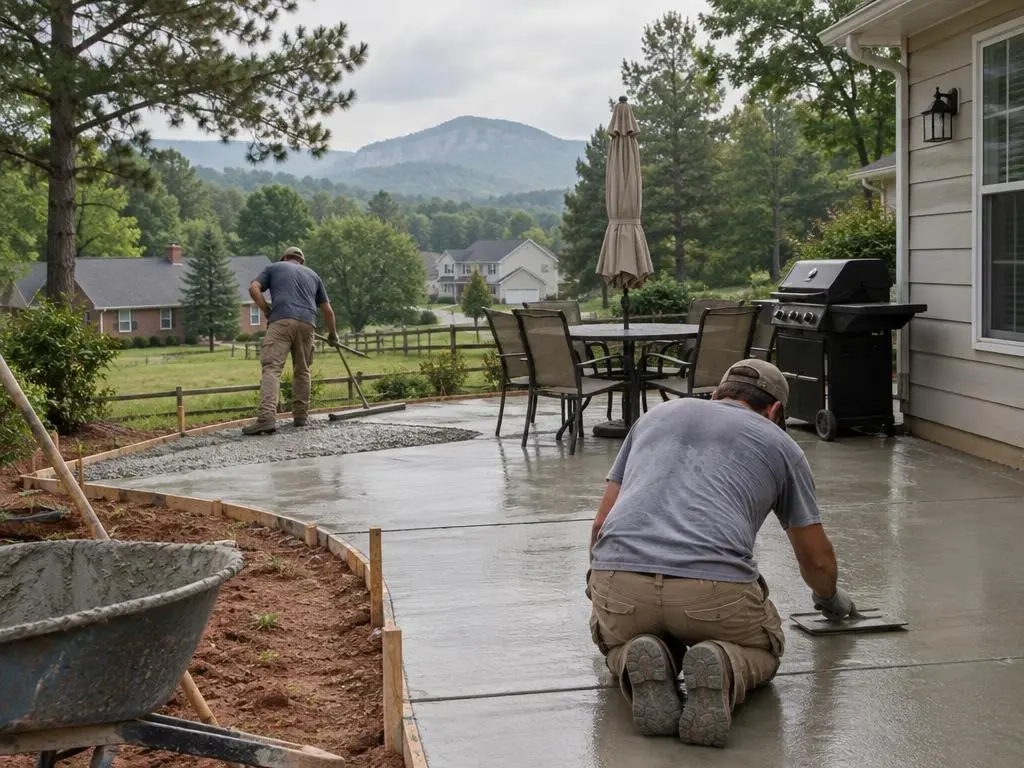
Why Homeowners Call Concrete Contractors Gastonia
The base gets the most work
Clay is the usual reason slabs here sink and split, so every pour sits on compacted soil and compacted crushed stone.
Prices you can read
Depth, stone, steel, finish, joints, tear-out and the total are spelled out in writing before anyone digs.
Pour days picked with care
Summer pours start early, and we watch the radar so a storm does not ruin a fresh finish.
Honest repair advice
When a patch will hold, you hear that. When the slab has failed underneath, we explain why new concrete is the better buy.
Get a Free Concrete Estimate in Gastonia
Describe the project and we will come out, measure and leave you with a written price.